Detecting and Treating Breast Problems

I’m going to start a series of articles about cancer. This subject is scary to everyone, but the more you know about it, the safer you are. Almost every week I see someone who had cancer or pre-cancer previously, and now is all better and back to normal. There has been tremendous progress in the detection of many types of cancer, and the treatment of them is much improved over what it used to be. Someone once told me the job of an ObGyn is to check every patient for cancer. When I see patients I always think of that. I’m going to write about it so the knowledge can make you safer. I have to say, though, that this blog is not intended as specific medical advice for your particular condition. If you think you have a breast lump or problem or concerns about cancer, you should see someone about it.

Today’s topic is Detecting and Treating Breast Problems.

Your breasts are made up of glands, fat and fibrous tissue. They respond to changes in hormones estrogen and progesterone during your menstrual cycle. This can result in a change in the amount of fluid in the breast that can make the fibrous areas more painful. Breasts also change during pregnancy, breastfeeding and menopause. You may notice changes in your breasts due to hormonal birth control, such as the pill or the ring, during hormone therapy, or if you have breast implants.

Most breast problems, especially in younger women, are benign. Common symptoms include lumps, discharge from the nipple, or pain.  Common breast problems include fibrocystic changes, cysts and fibroadenomas. Fibrocystic changes are changes that cause a woman’s breast to feel lumpy and tender. This can cause pain, itching and swelling, and usually occurs in both breasts. It frequently will become worse before a menstrual period and better after it is over. Cysts are small sacs filled with fluid. They can change with the menstrual cycle and are most often found in women between 25 and 50 years of age. Fibroadenomas are solid, benign lumps often found in young women. On physical exam they have a “slippery” feeling. Most women who have any of these problems do not have cancer, but you should let us know if you find something suspicious in your breasts. A physical exam and tests can help us find out what is there and what needs to be done about it.

Breast self-exam is something you can do to help find a lump or a change in your breasts.

A series of six illustrations showing how to d...

A series of six illustrations showing how to do breast self examination (BSE) (Photo credit: Wikipedia)

We usually recommend doing it after each period, or once a month if you are beyond the menopause. First you look at yourself in good light in front of a mirror. Look for dimpling, puckering, or redness of the breast. Then lie flat on your back and using your sensitive fingertips search one breast and then the other. If you think you have found a lump, you compare it with the same area on the opposite side, the “mirror-image” of it. If you can find something there that is similar, it may turn out to be normal tissue. You also look for a “dominant lump,” or one that is larger than the other normal-sized lumps, and you look for a lack of symmetry from side to side.

Breast problems are evaluated by physical exam, and by testing that includes breast ultrasound, mammography and MRI. We perform a clinical breast exam in our office at least once a year. We check for changes in size or shape, we look for dimples or redness of the skin. We feel for lumps that are larger than they should be, and we compare one breast with the other looking for a lack of symmetry. We check for enlarged lymph nodes. We look for a bloody nipple discharge. We look for areas of tenderness. In most cases an exam will be normal and no further testing is needed. In some cases, however, we send the patient to have more evaluation by breast ultrasound, x-ray or magnetic resonance imaging (MRI).

Breast ultrasound is a test using sound waves at a high frequency that create a picture of the inside of your breast. It is especially useful for determining if the interior of a lump is cystic or solid. Sometimes cysts are found, and the fluid within them can be aspirated out with the result that the cyst goes away. The fluid can be sent for analysis if there is a question about it. Often cysts will come and go with the menstrual cycle, and they do not have to be removed.

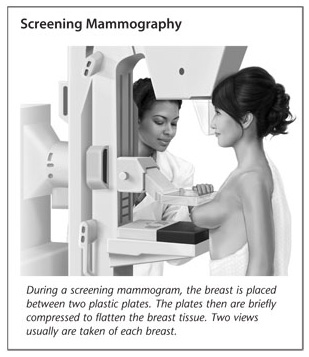
Mammography is used to examine breast tissue by x-ray. It should be done yearly starting at age 40, or sooner if you have factors that increase the risk of breast cancer such as genetic predisposition, or previous abnormal biopsy results. Mammography can find tiny lumps before they can be felt. We had a patient who had cancer detected by it and the size of the cancer turned out to be just 3 mm in size, about as large as a grain of rice. Cancers detected so early frequently can be cured by relatively simple and quick treatment. Mammography will also be used over time. The films from your first study are saved and are compared with later ones to more accurately detect changes. The test can sometimes be uncomfortable for you. It is less painful to have the test done after a period rather than before or during one.

There are two types of mammography, the routine screening test, or the diagnostic one. If you are going for a routine yearly mammogram you have the screening type, which uses fewer images. If you are having it done to answer a question about a symptom or lump, then the diagnostic one is more thorough and will give a specific answer in a detailed report. Another type of mammography you may hear about is digital mammography. This differs from standard mammography in the way the image is stored. Instead of x-ray film, the image is converted into a digital file and is stored on a computer. It may be enlarged or enhanced by a computer program. Digital mammography may be better at detecting cancer in some groups of women, such as those with more dense breast tissue.

The main downside to mammography is that it is not always accurate. It’s estimated that about 10% of cancers cannot be detected by mammography. So if you have a lump, and even though the mammography came back “normal,” you should call us about it if you believe it is becoming larger. Breast lumps that are becoming larger can be cancer, whether the lump hurts you or not.

A new test to evaluate the breast is MRI. Magnetic resonance imaging uses a strong magnetic field to create a detailed image of the inside of the breast. Women who have a high risk of breast cancer may have MRI in addition to mammography for breast cancer screening. This high risk refers to someone with a mutated BRCA gene as detected in a genetic test for breast cancer. MRI is not recommended for screening to detect breast cancer in all women because it is not as good as a mammogram for certain breast conditions, such as ductal carcinoma in situ (a type of early breast cancer).

If a lump or other problem is detected a fine-needle biopsy or surgical biopsy may be the next step. In that case the biopsy will obtain a small piece of tissue that will yield a definite result as to what the tissue represents. The results are reliable and will usually determine if the tissue is benign (not cancer) or if cancer is present and treatment is needed.

I hope this information has been helpful to you in getting a better understanding of the types of common breast problems that can occur, and how we evaluate them to detect those that are benign or malignant. In most cases the results are good and we can give reassurance that the problem is not a serious one. In some cases the results show cancer, but the treatment is available and very effective.

Breast cancer is a scary subject for all of us. We have many patients who have had breast cancer that was successfully treated. I see them year after year and they continue to be in good health, even 20 or 30 years later. Sooner or later you will hear of a close friend or co-worker who just found out that they have breast cancer. 10% of the female population will eventually get it. If you check yourself monthly, and have regular exams and screening tests you will be likely to have early detection and early cure, should it ever be discovered in your breast.

Reference: American Congress of Obstetricians and Gynecologists at http://acog.org

Posted in Gynecology, Our Office | Tagged , , , , , , , , , , | Leave a comment

New Genetic Tests, Easily Available

Through simple tests we can now learn answers to important questions about a great variety of risks that are based in genetics. The tests that are available can be helpful in many different categories, from early fetal life to mature life risks for the woman who has concerns about breast and ovarian cancer. We live in an amazing time and scientific breakthroughs in genetics are becoming available. In the future many more will be discovered.

First we will look at how testing can be done as part of Prenatal Care. According to the American Congress of Obstetricians and Gynecologists almost all children in the United States are born healthy. Only 2 or 3 out of 100 newborns have major birth defects. For the majority of these the cause is unknown. However, there are certain birth defects that can be tested before the baby is born. These include Down syndrome, Trisomy 13, Trisomy 18, and open neural tube defects.

The risk of having a baby with a chromosome abnormality, such as Down syndrome, increases with the mother’s age. However, ACOG recommends prenatal testing be offered to all pregnant women, regardless of age.

In our office as part of regular prenatal care we now provide the First Trimester Genetic Screening Test. This test was developed in England about 10 years ago, has become popular in the United States, and is now offered around the world. The First Trimester Genetic Screening Test is a simple finger-stick blood test performed on the pregnant woman, combined with an ultrasound of the fetus between 11 and 14 weeks of gestation. The ultrasound confirms the baby’s gestational age and measures the amount of fluid behind the baby’s neck. Results of the blood test and ultrasound are combined and used by a lab to estimate the risk of Down syndrome, Trisomy 13 and Trisomy 18. About 91% of Down syndrome cases are detected by this safe, reliable testing method. A negative test does not completely exclude the possibility of the baby being affected. If you want to have additional testing, it is available, even if you have a normal screening test result. Further tests that are available including CVS testing and amniocentesis. Each of those is highly accurate, but has a slight risk of complications including miscarriage, and so it is reassuring that the first trimester screening test is so very safe.

If you are screened for chromosome abnormalities in the first trimester, you should also be tested for neural tube defects such as spina bifida in the second trimester.  This is accomplished by a serum AFP test, routinely done between 15 and 19 weeks of pregnancy. High levels of AFP in the maternal serum may indicate that the developing fetus has a neural tube disorder. Most of the screening results will be normal. A positive screen occurs in about 5% of cases. If a positive screen occurs we will discuss the possible causes of it. This does not mean that the fetus is affected, as most are not. Further testing is available to help determine if a neural tube defect is actually present. If you decide to have further testing, we usually recommend a genetic specialist for it, where the risks of having further testing are very low and the results are highly accurate.

Generally accepted criteria for population testing (according to ACOG) are that the disease can impair health in the affected person, that there is a high frequency of carriers in the population to be screened, that reliable methods are available, technically valid and are cost-effective, and that the testing is voluntary, with counseling available if needed. Carrier screening in contemporary prenatal care is an excellent example of that. It can predict when a baby may be affected.

Such new tests, available now, offer genetic carrier testing for Cystic fibrosis (CF), Spinal Muscular Atrophy (SMA), and Fragile X syndrome. Cystic fibrosis is the most common lethal autosomal recessive disease in the U.S. One out of every 25 Caucasians with no family history of it is a carrier. The carrier rates are less in other ethnic groups: 1 in 45 Hispanics, 1 in every 65 Black Americans, and 1 in 90 Asians. It affects the respiratory, digestive and reproductive systems. It affects about 1 in 3300 people in the U.S. and causes the body to produce abnormally thick mucus, leading to life threatening infections. It does not affect intelligence. The average life span for an individual with it is 37.

Spinal Muscular Atrophy is the second most common lethal autosomal recessive disease in the U.S. It has a carrier frequency of about 1 in 41 people of all racial backgrounds, or 1 in 35 Caucasians. Every year about 1 in 6000 to 1 in 10000 babies is born with SMA. It is a severe, often fatal genetic disorder in which the muscles which are needed for breathing become progressively weaker and waste away.  The most common type causes respiratory failure and death by age 2. There is currently no treatment for it.

Fragile X is the most commonly inherited form of mental impairment. It is found in all racial and ethnic groups. It results from excessive CGG repeats on the FMR 1 gene found on the X chromosome. Fragile X is a disorder that causes mental retardation, autism and hyperactivity. It is found in 1 in 4000 males and 1 in 8000 females. One in every 260 women is a carrier for Fragile X, if they have no family history of mental retardation or autism. If MR or autism is present, the risk is greater.

Tay Sachs Disease is an autosomal recessive genetic disease found in Jewish individuals of Central and Eastern European descent. One in five Jews is a carrier for 1 of 19 severe and preventable genetic diseases. These diseases are autosomal recessive, so a carrier is healthy but at risk of passing on the gene mutation to his or her offspring. It is crucial that if one partner has a positive screening test, that the other partner should be screened as well. All at-risk individuals, including interfaith couples should be screened prior to pregnancy, if possible.  A simple blood test is all that is needed to screen for these diseases. If both parents are identified as carriers during pregnancy, there is a 25% chance that the baby could be affected. Further testing to evaluate the risk can be done at 11-13 weeks by CVS or at 16 weeks by amniocentesis.

We are also concerned about the genetic risks for breast and ovarian cancer. Breast and ovarian cancer can run in families. In every family, certain traits are shared and passed on from one generation to the next. Most obvious are physical traits such as eye or hair color, or resemblances that parents and children share. Less obvious are inherited genetic traits that control the tendency to develop specific diseases, such as certain cancers.

Most people don’t realize that about 10% of breast and ovarian cancers are hereditary. They are due to a mutated (altered) gene passed on from parent to child. You don’t actually inherit cancer, but rather a higher risk of developing it over time.

Even if there’s a pattern of breast and or ovarian cancer in your family, cancer doesn’t have to be inevitable.  You may benefit from learning more about your own risk. Cancer research shows that early detection along with proactive medical care aimed at prevention can reduce cancer risk and save lives.

You can have an inherited risk if:

  • you were diagnosed with breast cancer before the age of 50 and or ovarian cancer at any age
  • you have close family members diagnosed with breast cancer before that age of 50, ovarian cancer at any age, or male breast cancer.

We get two copies of every gene, one from our mother and one from our father. Because we inherit all of our different traits through our parents through a genetic blueprint, if either parent carries a BRCA mutation, we may carry it too. Two specific genes called BRCA1 and BRCA2 play a big part in preventing breast and ovarian cancers. Normally these genes protect us to prevent abnormal growth.  When they do not work properly certain groups of cells can grow without control and cancer may occur.

BRAC testing can help determine if you are at risk. Taking a closer look at your family history is the first step toward finding out if your risk is increased. BRAC testing is not like a mammogram or a pap test, which is offered to the general population. It’s specifically for people thought to be at high risk of breast or ovarian cancer, due to family history or due to developing breast cancer at a young age or ovarian cancer at any age. The test is done by getting a small sample of blood and sending it out for analysis. The result comes back in about a week. If negative, it means that your risk is no more than average. If positive, there are many steps that can be taken to minimize risk, including early and more frequent screening, more advanced screening techniques such as MRI, and even medications such as Tamoxifen or Evista that are known to reduce the possibility of getting cancer.

We live in exciting times where scientific advances enable us to know more about the future. Knowing your genetic risks can make your life safer. I’m sure that in the future there will be many more breakthrough advances that will give us a longer, healthier life.

Posted in Gynecology, Obstetrics, Our Office | Tagged , , , , , , , | 1 Comment

Modern permanent birth control by Essure

I’ve been very happy with the modern methods we use in our office for more and more procedures that used to require going to the hospital and having major surgery with general anesthesia. It’s amazing that we do procedures every day that did not exist a few years ago. Our practice is much better as a result. One of the greatest improvements has been in permanent birth control, or what we used to call “having a tubal.” The previous procedure used to cause pain as we inserted a scope through the patient’s navel, and there was some risk involved with hitting a blood vessel or a hidden abdominal structure. Then there would be cauterizing the patient’s tubes, with the risk that the cautery could be too much or too little, which could result in an injury or a pregnancy, respectively. While a permanent birth control method is not for those who are still planning to have children, there are many people who are definitely not planning to ever become pregnant in the future and don’t want to have to depend on birth control pills or other methods that require  a lot of effort or cost.

Today we are pleased to offer and perform the Essure in-office procedure which accomplishes the same objective in a better, safer, quicker, and less painful way. The Essure is a tiny insert made of a flexible nickel-titanium polyester alloy that we place inside the uterus where the tubes are attached to it. This area is very narrow, only about 1-2 millimeters in diameter (see the picture). To accomplish this we give the patient 4 kinds of oral pain medication (which we call a cocktail) that is taken before coming into the office. We then give additional pain medication as a shot and also we give local anesthesia for the cervix. A tiny instrument which is the insertion device is gently placed through the cervix. So there is no cutting, no scar, and hardly any pain or bleeding. This gives us a view from within the uterus, and we look up to see the tiny openings at the top where the tubes meet the uterus. We place the tiny device in first one side, and then the other. The procedure is done. It usually takes about 15 minutes total time for both sides to be completed and does not hurt more than having a period.

The opening of the right tube seen as it enters the uterus.

During the next 3 months each tube where the device has been inserted becomes blocked. We confirm this by doing a tubal dye test, and we get a report that shows a successful placement and successful blockage of both tubes. Not only is the procedure easy to do, but the results confirm it has worked before we advise patients to stop using birth control. The end result is a very convenient, safe, and effective method of having a permanent birth control with no cutting, no scar, and very little cost. As it is done in the office, there are no hospital charges for the person or for the insurance company.

We have been performing the procedure in our office for several years now, and the results have been great. If you are done having children, you should definitely consider having a permanent method that is so safe, easy and effective as this.

Posted in Our Office | Tagged , , , | Leave a comment

Pregnancy Ultrasound is Awesome.

The images that we see with modern ultrasound are amazing. The technology is much improved. Here is a picture of a fetus at 21 weeks of gestation taken at our office with our new GE ultrasound. You can see the features of its face very well. Ultrasound can be very helpful to evaluate the growth of the fetus, check its development, and look for problems. We can determine an accurate due date,  look for twins, help predict when the pregnancy is healthy, and when a miscarriage or tubal pregnancy could occur and evaluate pregnancy well-being as it progresses.

Here is a very early pregnancy at only 5 weeks of gestation. You can see that the measurement of the fetus, called CRL or crown rump length is only 2.8 millimeters! Even though the fetus is very small we were able to see the movement of the fetal heartbeat during the exam. When the fetal heartbeat is present, it means that the chance of having a miscarriage is very low.

This is an early pregnancy seen in 3D at 6 weeks of gestation. The fetus is the solid area in the center. Next to it at about the 2 o’clock position is an early supporting structure, called the yolk  sac. This is normal very early fetal development and seeing it is very reassuring .

By 12 weeks of gestation you can see the incredible changes that have occurred with the growth and development of the fetus. It is now much larger and we can see many more details of anatomy. This is the time of pregnancy where we perform a test called first trimester genetic screening which can help identify which fetus may have a greater risk of genetic problems including Down Syndrome, Trisomy 13 and Trisomy 18. In most cases the results are normal and we find out very early in pregnancy that the chance of a genetic problems is very low.

By 20 weeks the fetus is much larger, and the details of its anatomy are easier to see. We check for problems in the fetus, check the location of the placenta, look for its position, its growth and development to determine if they are all normal. By this point the pregnancy is half over, and the appearance of the fetus is becoming more and more what it will look like after it is born. Looking at the fetus with ultrasound gives us images that are magical.

Posted in Our Office | Tagged , , , , , | 2 Comments

Novasure treatment for vaginal bleeding is a significant improvement.

Novasure is a quick, safe and simple procedure to lighten or stop your periods, without the side effects of hormones or the risks of hysterectomy. We have been performing this procedure in our office for over 2 years and I have been impressed with how well it works. Just this past week I happened to see 3 patients who had this procedure done here in the past year or two. Each of them came in last week for a routine visit. They all reported that they did not have any bleeding since having the Novasure treatment. It reminded me of that old tv commercial involving the Maytag repairman. In the commercial he kept saying that he had little to do since Maytag washing machines hardly ever needed repair. Similarly I felt that after these patients were cured they did not need to come in to the office  because of having problems, but just for routine yearly visits. Before they were treated, they were having problems frequently. For these people the improvement in their quality of life was a huge change.

Many of our patients have heavy or irregular periods. Sometimes this may occur due to your age or due to being under stress or having an ovarian cyst. It may be a temporary condition that does not need to be treated. In many cases, however, the bleeding seems to persist and the consequences are heavy flow month after month resulting in a lower blood count with reduced energy and other symptoms. We have many such patients report these problems when they come in to see us.

1. Evaluation

Our first job is to make sure that the bleeding does not represent any potentially serious problem, such as cancer or pre-cancer. We evaluate the size of the uterus based on the physical exam, perform a pap test and look for other causes of bleeding such as pregnancy, tumors or cysts. Usually some testing is needed to make sure that a serious problem is not present. We often will evaluate the shape and size of the uterus and ovaries by ultrasound. This easy, modern test can be performed in our office without pain and is very useful in providing us with information that we need to evaluate the possible causes of bleeding. Sometimes it is also necessary to examine the uterus further such as by evaluating it’s interior visually (hysteroscopy) and getting a sample of endometrial tissue (D and C) to look for cancer or pre-cancer. This involves a short procedure which is usually done as an out-patient and for which anesthesia is given. Within a week or so the results are available and at that point we will have a meeting to bring together all of our information to come up with a plan of management.

2. Treatment choices

In many cases no treatment is needed, as the problem may be temporary and it may improve spontaneously. Sometimes, however, the problem is more serious and more thorough treatment should be performed such as by hysterectomy. This is particularly helpful when abnormal tissue that can lead to malignancy is found. In such a case we will discuss all of the treatment options before reaching a conclusion about what would be the best approach. On the other hand, in many cases the evaluation shows that treatment is needed, but a hysterectomy is more than is required. In these cases a minor procedure with major improvement such as Novasure may be the perfect choice.

Novasure is an office procedure that will bring a significant improvement in bleeding by either reducing it significantly or making it stop completely. It involves treating the inside of the uterus and destroying the tissue that causes bleeding. This is accomplished by inserting a slender wand that opens to have the appearance of a small copper fan. It conforms to the shape of the inside of the uterus. Precisely measured energy is delivered to the tissue and then the device is removed. This is known as endometrial ablation. The result is that the tissue no longer functions and the bleeding does not occur. The results can be dramatic.

The Novasure procedure is performed in our office. The entire procedure typically takes less than 5 minutes. It is performed without making any incisions. It can be performed under local anesthesia, I.V. sedation or general anesthesia. Most women report little or no pain, and return to their regular activities within a day.

Immediately after the procedure some women may have cramping. There may be a watery discharge as the tissue is healing. This is usually temporary and lasts for 7-10 days. In some cases there may be no discharge, and in some it may last longer. This is normal and it will go away when the healing is complete.

Novasure is highly effective for the treatment of abnormal vaginal bleeding, but it is not a birth control method. Because it treats the lining of the uterus, your chances of becoming pregnant after it are reduced. But it is still possible to become pregnant, and a pregnancy after an ablation could be dangerous for the mother and the fetus. It’s important to talk to us about different methods of birth control that are available if you are thinking about having a Novasure procedure done.

In my practice I have been impressed with how well this minor procedure works and brings about a major improvement. It usually will result in such an improvement in symptoms that hysterectomy will not be needed. This means that you will not need to miss much time from your work or from your family as your recovery will be rapid. I have found that our patients are very satisfied with the improvement from having a Novasure procedure. The studies that are quoted show that 95% of patients are satisfied with the results and 97% would recommend it to a friend.

This is another example of how medicine keeps changing, and the procedures that we used for many years and now being replaced by those which are much better in many ways. They are safer, easier for us to do, easier for the patient to have done, they have a faster recovery, give you more time for your family and for your work, and have fewer risks and complications. They cost less as they do not need to be done at the hospital.  They are less painful. While not for everyone,  if you have a problem with heavy vaginal bleeding Novasure is a safe and effective treatment that you should consider. It could be the best plan for you and significantly improve your life.

Posted in Gynecology, Our Office | Tagged , , , | Leave a comment

We Use Electronic Health Records!

One of my professional memberships is with an organization called the Physicians’ Electronic Health Record Coalition (PEHRC) where I serve as the newly elected Co-Chair. This organization of medical specialty societies helps to guide the futuristic goal of having all physicians in the United States use electronic health records (EHR) in their offices, and link these to many community resources including hospitals, laboratories, radiology centers, payers, pharmacies, patients, and other physicians. The use of this high technology has many advantages including accuracy, safety, and availability. They reduce your paperwork. They get your information accurately into the hands of the people who need it. We also are able to order laboratory tests and get results directly from the computer, leading to a much faster turn-around and the reduction of unnecessary testing. We can receive requests and send out prescriptions to pharmacies using this technology, a method that is called e-prescribing. They give you much more control of your health records and your health.

Steve Jobs, Apple Computer’s late visionary chief executive officer, was quoted as saying “Design is not just what it looks like and feels like. Design is how it works.” He also said “We want to stand at the intersection of computers and humanism.” This has relevance in the work that is being done today in this new field.

I recently attending a meeting of the PEHRC in which we discussed two important topics in this field, usability, and patient engagement. Usability refers to the design of the different programs which are used for EHR, and how easy or difficult they are to use in a simple, effective way. There is still much work to be done to make the health record programs aid the goal of helping improve the quality of medical care. Patient engagement refers to how patients can learn more about their own health through access to their health information and also to educational topics that can give them insight to the problems they may have, and how to keep their good health in the future. Improving patient engagement will allow computers to serve people in much broader and important ways than what is available today.

Our government has a web site www.healthit.gov where you can learn more about how Health Information Technology can lead to a safer, better and more efficient health care for you. I encourage your to visit it and get a glimpse of the future of health care.

We are proud to be using this new technology in our office, and with your help it will become even more meaningful in the years to come.

Posted in Our Office | Tagged , , , | Leave a comment

Vaginal Infections: A Guide

One of the common gynecologic problems that we frequently see is a vaginal infection. These infections cause inflammation of the vagina. The symptoms can vary but often include redness, swelling and irritation of the vaginal tissues. There can be a discharge, burning, itching and odor. Vaginitis does not pose major health problems, but it often does not go away on its own. Fortunately medications can be very effective in treating and curing infections of the vagina.

The vagina normally has microscopic organisms, as does the rest of the body. These bacteria break down substances in the vaginal secretions and produce an acidic environment which helps protect the vagina against infection by keeping down the number of potentially harmful organisms. However, the environment can sometimes be altered by antibiotics, douching too often, tampons, tight clothing, extra weight, diabetes, pregnancy, birth control pills, and having intercourse. A change in the acidity of the vagina can allow potentially harmful organisms normally living there to rapidly multiply and cause inflammation with an abnormal discharge.

A certain amount of vaginal discharge is normal. A normal discharge is clear or cloudy and doesn’t smell, itch or burn. If you notice a vaginal discharge that does not seem normal, and you notice burning, itching or odor, then an infection may be present. If you call us about it, we can see you and do an exam to determine the cause of your symptoms, depending on which type of infection may be present.

Many women believe that a yeast infection refers to any and all vaginal infections. Actually there are different types of vaginal infections. We will discuss the more common ones.

Yeast, also called Candidiasis, fungus, or Monilia, is the most common type of vaginal infection that causes symptoms of irritation. It is often hard to get rid of, and recurrences are common. Many women have a thick, white or greenish discharge that is odorless and looks like cottage cheese. The main symptoms are intense itching and  sometimes burning, with redness and swelling. It is more frequent among women who are pregnant, diabetic, or obese. Antibiotics, birth control pills, and any situation that promotes moisture, such as exercising, wearing a wet bathing suit, or having intercourse can lead to it. We often make the diagnosis of this infection during an exam where we examine a small amount of the discharge under the microscope. Yeast infections are usually treated with an anti-fungal medicine. It can be a cream which is available with or without prescription, or a prescribed pill such as Diflucan which is taken orally. In most cases treatment of the male sex partner is not necessary unless the symptoms seem to recur following the usual treatment. Sometimes a woman thinks she has a yeast infection when a different infection is present. If you have an infection that will not improve, please call us about it as more testing may be needed.

Bacterial Vaginosis, also call BV, is the most common cause of a malodorous vaginal infection. The main symptoms include a milky discharge with an odor. The odor becomes worse after having sex or having a period. If is often “fishy.” The cause of this particular infection is a group of organisms that occur naturally in the vagina. Here again it is simple for us to detect this vaginal infection during a pelvic exam and examining the discharge with a microscope. The treatment is a medicine called metronidazole which can be given in pill or in gel form. If you are given this prescription, it is important to remember to not drink alcohol during the time you are taking the medicine, for a severe upset stomach could occur. This infection can be transmitted back and forth during intercourse. In some cases we may recommend treating your partner as well.

Trichomonas and Group B Strep are other causes of a vaginal infection characterized by inflammation and itching. These infections are frequently mistaken for yeast as the symptoms are very similar. An examination by microscope or obtaining a culture can help distinguish which germ is responsible so that the right treatment can be chosen.

Sometimes more serious infections such as herpes or warts may be present. If you are not seeing an improvement, it is important to let us know about it.

There are things you can do to help keep the vagina healthy. Avoid spreading bacteria from the rectum to the vagina. After a bowel movement, wipe from front to back. Avoid irritating agents such as harsh soaps or detergents. Use condoms during sex. Avoid wet bathing suits and clothes that trap moisture by being too tight. Sometimes eating yoghurt can help replace the good bacteria that fights infection.

Vaginitis can be uncomfortable, but it is usually not harmful and it can be cured. If you suspect you may have an infection, call us about it. With good medical care, the problem will soon go away and you can resume your usual lifestyle without the worry and discomfort of a vaginal infection.

Posted in Gynecology, Our Office | Tagged , , | Leave a comment

Welcome

We welcome you to our practice of Obstetrics and Gynecology. Mark Seigel, MD, FACOG, Emily Gottlieb, FACOG,DO, Jennifer Jagoe, FACOG,MD and Supriya Mishra MD deliver babies and perform surgery at Shady Grove Adventist Hospital. We have two offices, at 11500 Old Georgetown Road, in Rockville, Maryland, and at 19785 Crystal Rock Drive in Germantown, Maryland. At our Rockville and Germantown locations we feature modern in-office surgery and a full complement of Obstretric and Gynecologic service. In the following pages you can find out more about our practice. Most insurance plans are accepted.

If you would like to make an appointment, call us at 301-468-4900 for the Rockville Office or 301-528-8444 for our new Germantown Office.

Posted in Our Office | Leave a comment